How to Sell Your Car Online in the UAE
Selling a car in the UAE looks simple from the outside: snap a few photos, post an ad, wait for offers. In practice, most sellers lose money or waste weeks because they skip one of three things an honest valuation, a clean set of documents, or a safe way to screen buyers.
This guide walks through the entire process from first decision to final Mulkiya transfer, with the actual RTA fees, the documents you'll be asked for, and the selling methods that genuinely fit the UAE market in 2026 including private listings, instant-cash buyers, dealer trade-ins, and online auctions.
Quick Answer
To sell your car online in the UAE: get a realistic valuation based on comparable listings, gather your Emirates ID, Mulkiya, and loan clearance letter (if financed), choose a selling method (private listing, instant buyer, trade-in, or online auction), screen buyers carefully, and complete the ownership transfer at an RTA-approved center which currently costs roughly AED 350–400 for the transfer plus AED 170–200 for a roadworthiness inspection if your car is over three years old.
Step 1: Choose the Right Selling Method for You
There's no single "best" way to sell a car in the UAE the right method depends on whether you value price, speed, or convenience most. Here's how the main routes actually compare.
Private listing (classifieds) Typical price: highest. Speed: slowest (weeks). Effort: high photos, calls, viewings, negotiation. Watch out for: time-wasters, lowball offers, fake buyers.
Instant-cash buyer / "we buy any car" Typical price: below market. Speed: fastest (same day). Effort: low. Watch out for: the price is set to leave the buyer a resale margin.
Dealer trade-in Typical price: lowest. Speed: fast. Effort: very low. Watch out for: usually the weakest price of all four options.
Online car auction Typical price: market-driven. Speed: days. Effort: low-medium. Watch out for: depends on genuine buyer competition on the platform.
An online auction sits in an interesting middle ground: instead of one buyer naming a price, your car goes in front of multiple verified bidders competing against each other, which tends to push the final number closer to true market value than a single instant-offer quote while still avoiding the endless calls and viewings of a private ad.
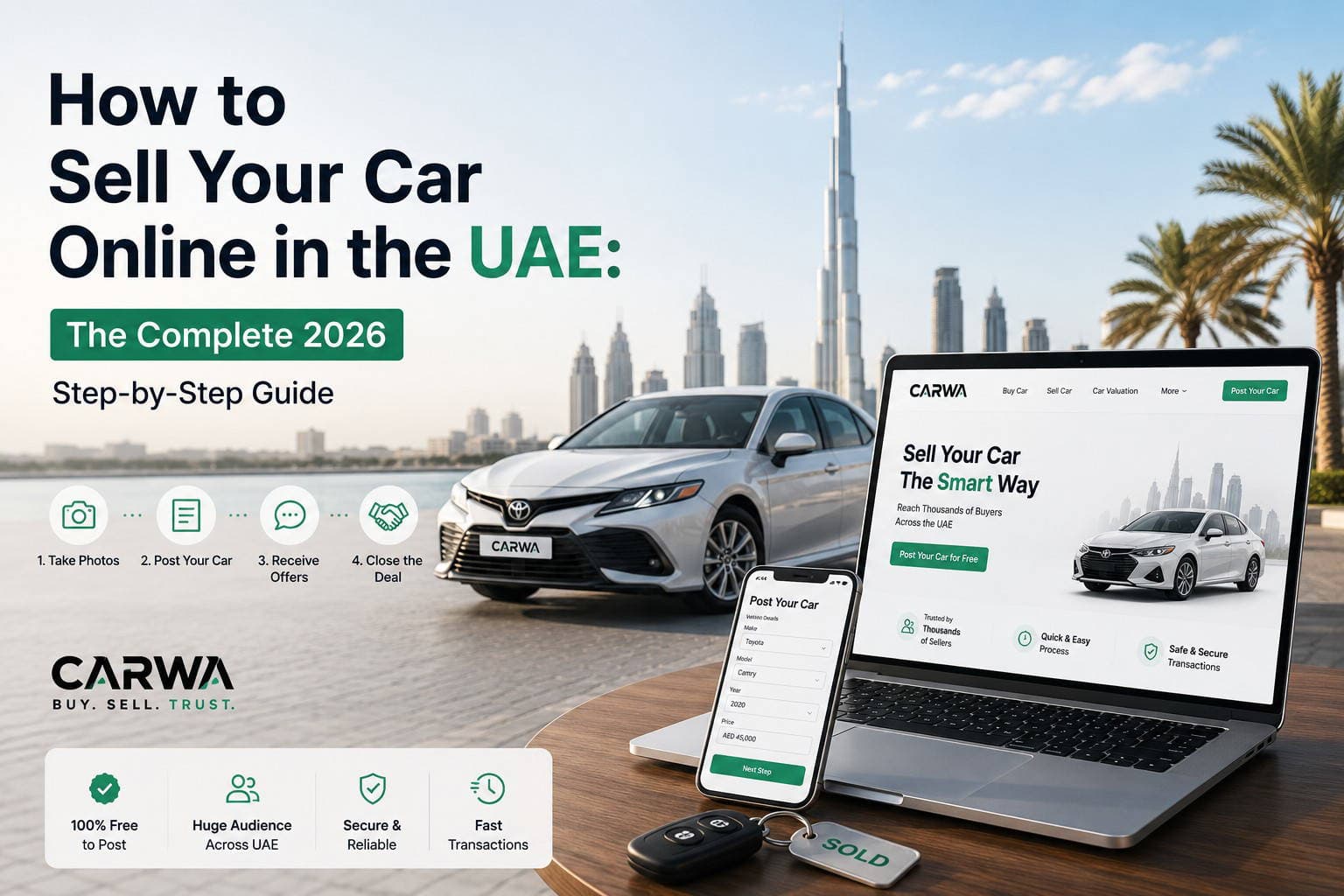
This is the model Carwa runs in the UAE. You list your car once, it's inspected, and it goes live for real-time or auto-bid auctions among verified buyers no back-and-forth calls, no haggling in a parking lot, and no cash changing hands, since payments are settled securely online. It's a genuinely different middle path between "sell it yourself" and "take whatever a dealer offers."
Whichever route you pick, the preparation, documents, and legal transfer steps below apply to all of them.
Step 2: Get an Honest Valuation First
Overpricing is the single biggest reason cars sit unsold in the UAE for months. Before you touch a listing, work out a realistic number.
What actually moves the price:
Specification GCC-spec cars (built for Gulf heat and dust) hold value noticeably better than US, European, or Canadian-spec imports, which buyers often discount for cooling-system and parts-availability concerns.
Mileage vs. age a low-mileage older car frequently outsells a newer car with heavy kilometers, since UAE buyers associate mileage with air-con compressor and gearbox wear more than with the model year.
Service history a documented service book at an authorized dealer or reputable garage can add several percentage points to your final offer; buyers without it assume the worst and price accordingly.
Accident and paint history a clean, unrepaired panel history matters more here than in many markets, since UAE buyers can pull a vehicle history report cheaply before committing.
How to check comparable value: pull up 5–8 live listings for the same make, model, year, and trim across a couple of platforms, exclude the obvious outliers (either wildly cheap or clearly overpriced dealer stock), and set your asking price in the lower half of that range if you want a faster sale, or the upper half if you're prepared to wait and negotiate.
Step 3: Gather Your Documents Before You List
Buyers in the UAE move fast once they're interested missing paperwork is what kills deals at the last minute. Have these ready before you post anything:
Emirates ID (valid, not expired) required for identity verification at every stage, including the RTA transfer.
Mulkiya (vehicle registration card) proves legal ownership; handed to the buyer at transfer.
Loan clearance letter / bank NOC mandatory if the car was financed; the bank must confirm the loan is settled before any transfer can proceed.
Service history / warranty book not legally required, but strengthens your asking price.
Valid comprehensive or third-party insurance the buyer's insurer will typically need to confirm cover is active before transfer.
Salik account details so you can settle or transfer any outstanding toll balance after the sale.
If you're leaving the UAE, note that visa cancellation and vehicle deregistration are two separate processes selling or exporting the car needs to happen (or at minimum be initiated) before your final departure, since an unsold, unregistered vehicle left behind can still generate fines under your name.
Step 4: Prepare the Car and Take Photos That Sell
A clean, well-photographed listing consistently outperforms a messy one at the same price, because UAE buyers browse dozens of near-identical listings and decide which ones to click within seconds.
Wash and detail the exterior and interior, and address any obvious dashboard warning lights before viewings even minor unresolved issues get read as a red flag.
Photograph in daylight, from all four exterior angles, plus the odometer, engine bay, tyres, and any existing scratches or dents (photographing damage yourself, honestly, builds more trust than a buyer discovering it later).
Remove personal items and keep the number plate visible in at least one shot.
Write a description that states mileage, year, spec (GCC/US/Euro), accident history, and service history up front listings that hide this information get fewer serious inquiries, not more.
Step 5: List, Auction, or Submit for an Instant Offer
Depending on the method you chose in Step 1:
Private listing: post on a UAE classifieds platform with complete specs and your researched price; expect the bulk of genuine inquiries in the first 5–7 days.
Instant-cash buyer: submit your car's details online, get a preliminary quote, then have it physically inspected the final offer is usually adjusted (up or down) based on that inspection.
Dealer trade-in: get your trade-in value quoted alongside the price of your next car; useful mainly for convenience, not for maximizing what you receive for the old vehicle.
Online auction: submit the car for inspection, receive a condition report, and let it go live for bidding you see competing bids in real time rather than negotiating with one buyer at a time. On Carwa, this whole flow inspection, listing, and live or auto-bid auction happens within one platform, so you're not juggling a separate valuation tool, a separate classifieds ad, and a separate buyer-screening process.
Step 6: Screen Buyers and Avoid Scams
Private sales carry the most risk simply because there's no platform standing between you and the buyer. A few rules that consistently prevent problems:
Meet at a public, well-lit location an RTA center or typing center is ideal since you'll end up there anyway for the transfer.
Accept cash or a verified bank transfer only. Personal cheques carry real fraud risk in the UAE; sellers have lost tens of thousands of dirhams to bounced cheques after handing over keys and documents.
Confirm any bank transfer has actually cleared in your account not just that a payment confirmation screenshot was sent before releasing the Mulkiya, keys, or plates.
Verify the buyer's Emirates ID matches the name that will appear on the sale contract.
Put the price, date, and condition of the car in a simple written agreement that both parties sign, even for a private, informal sale.
Step 7: Complete the RTA Ownership Transfer
No sale is legally final in the UAE until the RTA reissues the Mulkiya in the buyer's name. Skip this step and the car including its future fines and Salik charges remains legally yours.
Ownership transfer fee: AED 350–400
Roadworthiness inspection (cars over 3 years old): AED 170–200
Knowledge & Innovation fee: roughly AED 20–30
New number plate (only if requested): varies by plate type
The process, step by step:
Clear any outstanding traffic fines and Salik balance the RTA will not proceed while fines are unpaid.
Book (or walk into) an RTA-approved vehicle testing center for the inspection, if your car is over three years old.
Both buyer and seller attend an RTA center or approved typing center with Emirates IDs and the Mulkiya, or a notarized power of attorney if either party can't attend in person.
Confirm the buyer's insurance is active on the vehicle before the transfer is processed most centers require this.
Pay the transfer and inspection fees, and the RTA issues a new Mulkiya in the buyer's name, either on the spot or digitally shortly after.
If you sold through an auction or platform that issues a Sale and Purchase Agreement (SPA) certificate, note that it typically carries a 14-day validity window completing the transfer after that can mean a re-issuance fee, so don't delay this step.
Step 8: Cancel Insurance and Settle Salik
Once the Mulkiya has changed hands:
Contact your insurer to cancel or transfer the policy; ask specifically about a refund for unused months, since most insurers will return a prorated amount minus admin fees.
Log in to your Salik account and either deactivate the tag or transfer it to a new vehicle; any remaining balance can typically be refunded or carried forward.
Conclusion
Selling a car in the UAE isn't complicated once you break it into its actual parts: know what the car is really worth, have your paperwork in order before a buyer asks for it, pick a selling method that matches how much time versus price you're willing to trade, screen whoever you're dealing with, and finish the job properly at the RTA. Most sellers who feel like they "got a bad deal" skipped one of those steps, not all of them.
If you'd rather not spend two weeks fielding lowball calls or handing your Mulkiya to a dealer at a discounted trade-in price, an online auction is worth trying first. Carwa lets you list your car once, get it properly inspected, and let verified buyers compete for it in a live or auto-bid auction with secure online payment instead of cash in a parking lot. You get a market-driven price without doing all the legwork of a private sale yourself.
Ready to see what your car is worth? Start your listing on Carwa and get it in front of real, verified buyers today.