Documents You Need for Selling a Car in UAE
If you've ever shown up at an RTA transfer centre only to be sent home over a missing document, you know exactly how frustrating that moment is. An expired Emirates ID, a Mulkiya that doesn't quite match your name, an old parking fine from a different emirate any one of these can stop a sale in its tracks. The good news is that none of it is unpredictable. Once you know what the UAE actually requires, gathering the paperwork takes an afternoon, not a week.
This guide walks through everything you need as a seller, what your buyer has to bring, and the extra steps for financed cars, company-owned vehicles, expats leaving the country, and sellers who can't make it to the transfer centre in person.
Quick Answer
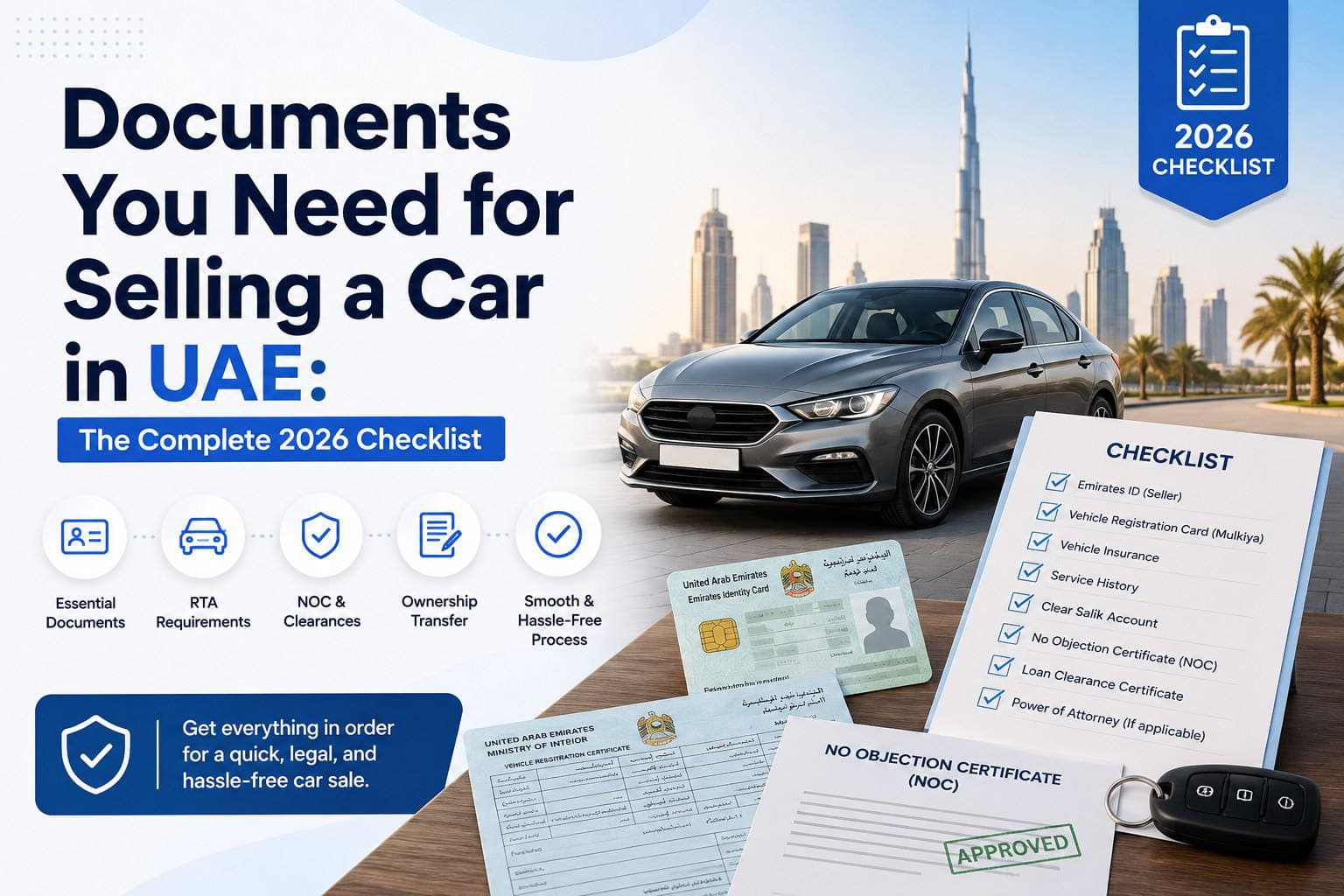
To sell a car in the UAE, you'll need your original Emirates ID, the Mulkiya (vehicle registration card), a valid UAE driving licence, and a passport/visa copy. Your buyer needs valid insurance in their own name before the transfer can go through. If the car is over three years old, add a vehicle inspection certificate to the pile. Got a loan on the car? You'll need a bank clearance letter or NOC. And every traffic fine and Salik balance has to be cleared before the RTA will touch the file. Both of you then complete the transfer together at an RTA Customer Happiness Centre or an approved service centre
The Core Documents Every Seller Needs
These four are non-negotiable for any private sale, whether you're doing this in Dubai, Abu Dhabi, Sharjah, or anywhere else in the country.
Original Emirates ID. Both you and the buyer need a valid, unexpired card it's the primary check the RTA system runs against its records, and there's no getting around it. If yours has lapsed, you'll either need to renew it before your appointment or bring your original passport with a valid residency visa as a stand-in.
Vehicle Registration Card (Mulkiya). This is your proof of ownership, and it needs to match your Emirates ID exactly same name, correct spelling. A mismatch here is one of the more common (and easily avoidable) reasons sales get held up. If you've misplaced the card, sort out a replacement through the RTA before you list the car; you simply can't sell without it.
A valid UAE driving licence. Both parties need one, and it doesn't matter which emirate issued it. A Sharjah licence works just as well in Abu Dhabi.
Passport and residency visa copies. Standard for both sides, particularly if either of you is an expat. If the buyer holds residency in a different emirate, expect the centre to ask for a bit more more on that below.
What the Transfer Itself Requires
Once your basic paperwork is sorted, a handful of process-specific documents come into play.
Document | Who provides it | Why it matters |
|---|---|---|
Buyer's insurance policy | Buyer | The RTA won't register a new owner without active cover already in place |
Vehicle inspection certificate | Seller (if car is 3+ years old) | Confirms the car is roadworthy |
Signed sale agreement | Both parties | Not always mandatory, but it protects everyone involved |
Bank clearance letter / NOC | Seller (if financed) | Proves the loan is settled or being taken over |
Fine and Salik clearance receipts | Seller | Nothing moves while there's an outstanding balance |
A couple of things worth knowing here. On insurance: your buyer needs a policy active in their name before the change of ownership goes through no exceptions. If your own policy still has seven months or more left on it, some insurers will let you transfer it across to the buyer, though not all will, so it's worth a quick call to your provider before you assume that's an option. And don't cancel your own cover the moment the deal is agreed wait until the Mulkiya has actually changed hands, because until then you're still the registered owner on paper, fines and all.
As for the sale agreement, it isn't always required at the counter, but having a dated, signed copy is genuinely worth the five minutes it takes. Quite a few RTA-linked apps now let you sign digitally through UAE Pass, so it doesn't even need to be a paper hassle anymore.
Selling a Car With an Outstanding Loan
You can't legally transfer a car in the UAE while a bank still has a mortgage registered against it full stop. This trips up more sellers than almost anything else on this list, mainly because clearing a loan takes a few working days, and people tend to leave it too late.
You've got two options. Either you settle the outstanding balance yourself, at which point the bank issues a clearance letter and notifies the RTA directly (this usually takes one to two business days to reflect in the system), or your buyer takes over the remaining finance, in which case the bank issues a No Objection Certificate (NOC) once they've assessed the buyer's eligibility. That second route usually means a joint visit to the bank with your buyer.
Either way, start this process several days before you actually want to complete the sale. Turning up at the RTA with a loan still on file is an automatic no.
Clearing Fines and Salik First
Here's the thing most sellers underestimate: outstanding fines are the single biggest cause of a blocked transfer more common even than an expired ID. And the RTA checks across every emirate, not just the one you're transferring in. A speeding ticket from Abu Dhabi or a parking fine from Ajman will stop a Dubai transfer just as effectively as a local one would. You can check and settle these through the RTA's official portal, the Dubai Police app, or the relevant emirate's own traffic authority.
Salik works the same way. Log into your account, clear whatever's outstanding, and either deactivate the tag or arrange to hand it over with the sale. Leave it active on a car that's no longer yours, and you'll keep getting charged for someone else's toll trips.
When You Need a Vehicle Inspection
Not every car needs one, but most used vehicles do. Anything older than three years from its first registration date has to pass a technical inspection at an RTA-approved centre before it can change hands brakes, tyres, lights, suspension, emissions, the usual checklist. Cars under three years old are generally exempt.
The certificate is only valid for 30 days, so timing matters book it too early and it can lapse before you've actually found a buyer. Expect to pay somewhere around AED 120–150 for the initial test, with a retest running about AED 50 if something needs fixing first. Worn tyres, faulty brake lights, and emissions above the limit are the usual culprits, and none of them take long to sort out if you catch them early.
Selling a Company-Owned Vehicle
If the car is registered to a business rather than an individual, expect a bit more paperwork on top of the standard list:
A current trade licence copy
A company authorisation letter, stamped, naming whoever is permitted to complete the sale
The authorised signatory's passport and Emirates ID
A Power of Attorney, if the person signing isn't the company owner
The same inspection certificate and loan NOC as any other sale, where applicable
These transfers go through the same RTA centres, but they typically take a little longer because there's an extra layer of verification on who's actually authorised to act for the company.
Selling From Outside the UAE (Power of Attorney)
This is the part most guides skip over entirely, and it comes up more than you'd think. If you've already left the UAE, your residency visa has lapsed, or you just can't get to a transfer centre in person, you can still sell your car legally by appointing someone to act on your behalf through a Power of Attorney (POA).
A properly drafted vehicle POA gives your representative the legal right to clear fines, pass the inspection, sign the sale agreement, and collect the money all strictly within whatever scope you've written into the document. Here's roughly what you'll need to set one up:
Document | UAE resident | Non-resident |
|---|---|---|
Your passport copy | Required | Required |
Your Emirates ID copy | Required | Not applicable |
Agent's passport and Emirates ID | Required | Required |
Mulkiya copy | Required | Required |
Bank NOC (if financed) | If applicable | If applicable |
The document has to be notarised, either at a notary office in person or through remote e-notarisation, which usually just means a short video call to verify your identity. Most people go with a Special (limited) POA rather than a general one it restricts your agent to the exact car and tasks you've named, which is a sensible safeguard. Budget somewhere around AED 1,000–1,500 for the whole thing, covering the notarisation and the mandatory Arabic translation. You can find more detail on the process through the Dubai Courts' digital services or the UAE Ministry of Justice.
Leaving the UAE Permanently and Taking the Car With You
If you're relocating and want to export the car rather than sell it, the paperwork changes entirely. You'll need to apply for an Export Certificate through the RTA, pass an export test, and hand back your number plates. The certificate is valid for 30 days and typically costs around AED 100–120. If you're leaving before a sale is finalised, setting up a POA in advance (as above) means the deal can still close after you've gone.
Selling an Inherited Vehicle
This one genuinely doesn't get covered anywhere, but it's more common than you'd guess. If the registered owner has passed away, a family member can't simply walk in and sell the car using their own documents it has to go through the inheritance process first. That means a succession certificate or inheritance decree from the UAE courts confirming who the legal heirs are. From there, the car is usually either transferred into the heir's name before being sold on, or a court-appointed executor is given authority to sell it directly. Either way, the RTA will want the court paperwork alongside the usual Mulkiya, ID, and clearance documents. It's a longer process than a standard sale, so it's worth getting the legal side moving early with a lawyer or through the courts before you start looking for a buyer.
If Your Buyer Lives in a Different Emirate
Worth flagging: if your buyer's residency visa is registered somewhere other than where you're doing the transfer, they'll usually need to register the car in their home emirate instead, and may be asked for proof of address there a tenancy contract or a recent utility bill, typically. This restriction doesn't apply to UAE nationals, who can register a car in any emirate they like.
What It All Costs
Item | Approximate Cost (AED) |
|---|---|
RTA transfer fee (light vehicle) | 350–400 |
Vehicle inspection | 120–150 |
Inspection retest (if needed) | ~50 |
Export certificate | 100–120 |
Vehicle POA (notarisation) | 1,000–1,500 |
Replacement Mulkiya (if lost) | Varies by emirate |
Treat these as ballpark figures rather than fixed pricing costs shift slightly depending on the emirate and the exact service centre you use. If you want a fuller sense of what selling actually costs beyond documentation, our guide on how to price your used car competitively in the UAE is worth a read before you list.
Your Pre-Transfer Checklist
Run through this before you book your RTA appointment:
Confirm your Emirates ID, Mulkiya, and driving licence are all valid and current
Settle every traffic fine, across all seven emirates, not just your own
Clear your Salik balance and either deactivate or transfer the tag
Settle any outstanding loan and get the clearance letter or NOC in hand
Book the inspection if the car is over three years old, and time it so the certificate is still valid on the day
Confirm your buyer has arranged insurance in their own name
Prepare a signed sale agreement — not mandatory everywhere, but sensible
If you can't attend in person, get a notarised Power of Attorney sorted in advance
Head to the RTA Customer Happiness Centre or an approved transfer centre together with the buyer
Submit the documents, pay the transfer fee, and sign the agreement
Make sure the buyer receives the updated Mulkiya in their name
Cancel your own insurance only once the transfer is fully confirmed
Mistakes That Slow Everything Down
A few things trip up even experienced sellers, and all of them are avoidable with a bit of forward planning:
An expired Emirates ID or Mulkiya. Check the dates a week ahead there's no renewing on the spot at the counter.
A forgotten fine from another emirate. The system checks nationwide, so something from years ago and hundreds of kilometres away can still stop you cold.
Leaving loan clearance to the last minute. Banks need one to two working days minimum, so don't start this the morning of your appointment.
A buyer who shows up without insurance. Confirm this with them beforehand rather than assuming they've handled it.
Name mismatches between the Mulkiya and Emirates ID. Sort these out with the RTA in advance, not at the counter.
Conclusion
Selling a car in the UAE isn't complicated once you know the sequence: identity documents, ownership proof, insurance for the buyer, a clean fine and loan record, and an inspection if the car needs one. Special situations a company car, a sale from overseas, an inherited vehicle just add a specific document or two on top of that same foundation. Get the paperwork sorted before you start talking to buyers, and the actual transfer at the RTA becomes the fastest part of the whole process, often wrapped up in an hour or two.
If you're at the stage where the documents are ready and you just need a serious buyer, that's where we come in. Head over to Carwa's sell your car page to list your vehicle and connect directly with verified buyers across the UAE, or check our how it works guide for a full walkthrough of the process from listing to handover.